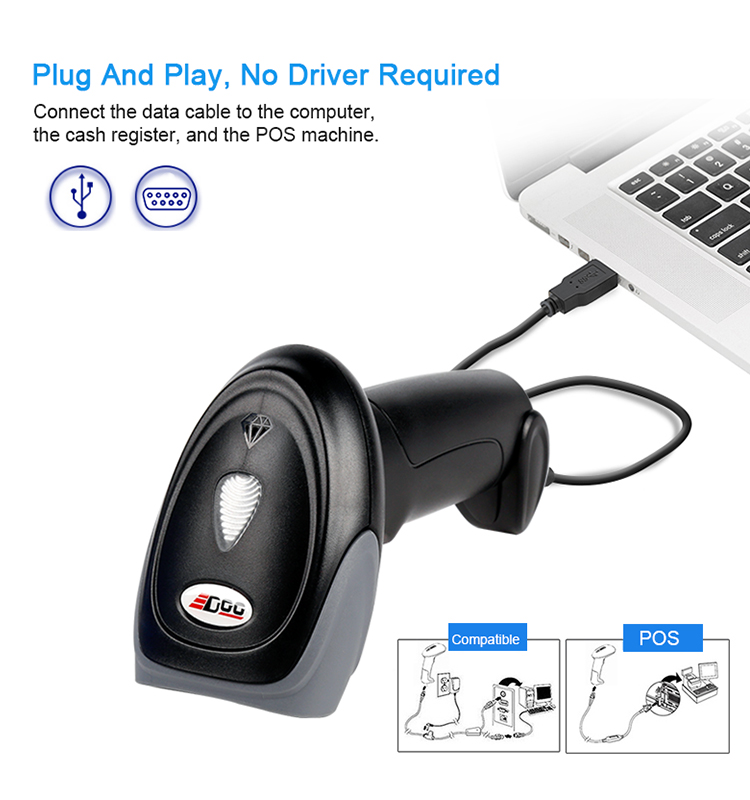
With the accelerated digitalization of fields such as the Internet of Things (IoT), industrial manufacturing, and smart logistics, the difficulty in reading non-standard QR codes (such as blurred, distorted, and stained ones) has long been a key bottleneck restricting the efficiency of industrial data collection. Our company's world's first dual-CPU architecture dual-core high-performance QR code scanner has achieved a comprehensive leap in decoding performance through technological breakthroughs, providing efficient and accurate scanning solutions for various industries. Below are the most frequently asked questions from users, with detailed answers:
I. Core Technology Related
Q1: What are the core breakthroughs of the dual-CPU architecture of this scanner compared with traditional single-CPU scanning devices?
A1: The core breakthrough lies in breaking the performance bottleneck of traditional single-CPU serial processing. It adopts a dual-CPU parallel collaborative working mode — one CPU is specially responsible for image collection and processing, quickly capturing QR code images and performing preprocessing optimization; the other CPU is specially responsible for decoding algorithm operations, focusing on parsing various barcode information. The two work in parallel and perform their respective duties, fundamentally improving image processing speed and decoding efficiency, completely solving the problems of slow decoding and easy stuttering of traditional devices, and achieving a leapfrog upgrade in QR code recognition technology.
Q2: What specific performance improvements can the dual-CPU architecture bring? Are there clear performance comparison data?
A2: The performance improvements brought by the dual-CPU parallel architecture are mainly reflected in two core dimensions: First, the image processing speed is increased by more than 50% compared with traditional single-CPU devices, which can quickly capture high-speed moving or long-distance QR code images, reducing reading failures caused by blurred images and motion blur. Second, the decoding efficiency — the decoding response speed for complex barcodes is increased by more than 30%. Combined with the optimized decoding algorithm, the 2D imaging speed can reach 5 times that of traditional scanning engines. Even for non-standard QR codes such as blurred, distorted, and stained ones, it can achieve fast and accurate reading, with a first-read success rate of over 99.5%, greatly reducing the number of repeated scans and improving data collection efficiency.
Q3: Will the dual-CPU architecture increase device power consumption? How is the device's battery life?
A3: No. While adopting the dual-CPU architecture, our company has carried out power consumption optimization design. Through an intelligent scheduling algorithm, the two CPUs dynamically adjust their operating status according to the actual working scenario, automatically reducing power consumption when idle and working efficiently in coordination when in use. This ensures that while performance is improved, the power consumption is basically the same as that of traditional single-CPU devices. The handheld version is equipped with a large-capacity battery, which can meet the needs of all-day continuous work. It is matched with a convenient charging base for efficient charging, fully adapting to the needs of high-frequency scanning scenarios such as logistics sorting, supermarket checkout, and customs verification.
II. Function Adaptation Related
Q4: What specific scenarios can the scanner's optimization for non-standard QR codes handle?
A4: Relying on the powerful computing power of the dual-CPU architecture, the device has been specially optimized for non-standard QR codes such as blurred, distorted, stained, and incomplete ones. It also supports stable reading under complex lighting environments such as strong light and weak light, and can widely cope with various complex scenarios: worn and stained product barcodes in industrial manufacturing, wrinkled and damaged package labels in the logistics industry, possible blurred passport MRZ codes in customs and hotel scenarios, and scanning needs under different lighting environments such as outdoor strong light and indoor dimness. It can achieve accurate reading and adapt to complex working conditions in multiple industries.
Q5: In addition to the core dual-CPU decoding advantage, what other auxiliary functions does the device have to improve the user experience?
A5: In addition to the leap in decoding performance brought by the dual-CPU architecture, the device is also equipped with a number of practical auxiliary functions to comprehensively improve the user experience: First, a cross laser aiming system. The clear cross laser line can quickly and accurately locate the scanning area, allowing even beginners to complete scanning with one click quickly, reducing operation difficulty. Second, a long depth of field reading module, which balances fast short-distance scanning and accurate long-distance reading, eliminating the need to deliberately get close to or stay away from the scanned object, adapting to different use distances. Third, a professional passport reading function, which can accurately parse the MRZ machine-readable area of the passport and quickly extract core identity information, adapting to foreign-related scenarios such as customs, hotels, and tourism. Fourth, rich interfaces and communication methods, supporting multiple communications such as USB keyboard and virtual serial port, customizable RS232 interface, and optional Bluetooth and 2.4G three-in-one communication, flexibly adapting to different terminal devices.
Q6: What code systems does the device support? Can it meet the general needs of multiple industries?
A6: The device is fully compatible with various conventional 1D and 2D barcodes on the market, including commodity barcodes, payment QR codes, electronic ticket QR codes, industrial barcodes, etc. It also supports professional reading of passport MRZ machine-readable codes, realizing one machine for multiple uses without the need to equip additional devices. Whether it is civil scenarios such as retail, logistics, hotels, tourism, and customs, or industrial scenarios such as industrial manufacturing and assembly line production, it can meet the needs of efficient scanning and information collection, achieving full-scenario adaptation.
III. Scenario Application Related
Q7: What specific application value does the decoding advantage of the dual-CPU architecture have in scenarios such as customs and tourism?
A7: In the customs scenario, relying on the high-speed decoding capability of the dual-CPU, the device can quickly read passport MRZ machine-readable codes and various declaration barcodes, replacing manual entry, realizing one-click collection and rapid verification of passenger identity information, greatly improving customs clearance efficiency and reducing passenger waiting time. In the tourism scenario, it can quickly read ticket QR codes and tourist passport information, adapting to the needs of scenic spot ticket checking and foreign-related tourism identity verification, improving the tourist experience. In the logistics scenario, it can efficiently read stained and wrinkled barcodes on packages, improving sorting and inventory efficiency, and reducing logistics delays caused by barcode reading failures. In the industrial manufacturing scenario, it can accurately read non-standard product barcodes on the production line, helping to realize digital traceability of the production process.
Q8: How is the device's environmental adaptability? Can it cope with harsh industrial or outdoor scenarios?
A8: The device has extremely high environmental adaptability, which can adapt to various lighting environments (including completely dark environments). At the same time, it can work stably within a wide range of temperature and humidity, and can withstand harsh and complex working environments such as impact, vibration, and strong exposure. The body is made of durable materials and has passed strict drop tests, making it sturdy and durable. Whether it is an outdoor tourism scenario, an industrial production workshop, or a complex environment such as a customs port, it can ensure stable operation of the device and meet the needs of long-term high-frequency use.
IV. Procurement and After-Sales Related
Q9: What is the customs code of this dual-CPU architecture scanner? What precautions should be taken for import and export declaration?
A9: The 10-digit HS customs code of the device is 8471605000, which belongs to the category of "Scanners for Automatic Data Processing Equipment" and is applicable to the import and export declaration of QR code scanners and barcode scanners worldwide. The 13-digit customs declaration code (10-digit HS code + 3-digit CIQ code) is 8471605000.999, which is applicable to formal customs declaration procedures. When declaring, key elements such as brand type, brand name, model, and GTIN need to be provided, and it must meet the requirements of entry civil commodity certification (inspection and quarantine category L). The export tax rebate rate is 13%, and the personal postal import tax rate is 15%.
Q10: What is the device's warranty policy? How to handle failures?
A10: The device enjoys nationwide warranty service with a warranty period of 1 year. For failures caused by non-human damage during the warranty period, free repair or replacement service is available, and we bear the round-trip shipping costs. We respond to after-sales needs within 4 hours on working days and provide solutions within 48 hours. If the device fails, you can contact us through the official website after-sales channel or customer service hotline, and we will arrange professional technical personnel to provide one-on-one guidance to ensure that the problem is solved quickly without affecting your normal work.
Q11: Does the device support customized services? Such as interface customization, function adaptation, etc.?
A11: Yes. We can provide customized services according to the personalized needs of different industries and customers, including interface customization (such as RS232 interface customization), communication method customization, function adaptation (such as barcode reading optimization for specific scenarios), etc. At the same time, we can provide professional technical docking services to ensure that the device perfectly adapts to your actual use scenario and meets personalized scanning and information collection needs.
If you have other unmentioned questions, you can contact us through the official website online customer service or customer service hotline, and we will provide you with professional and detailed answers and services.

 +86-18050089566(WhatsApp/wechat)